Amid a tight U.S. labor market, irrigation technician roles are gaining attention for their stable demand, trainable skills, and solid benefits. For example, JRL Lawn Sprinkling Systems Inc. in Addison, Illinois, is hiring full-time technicians—no experience required.
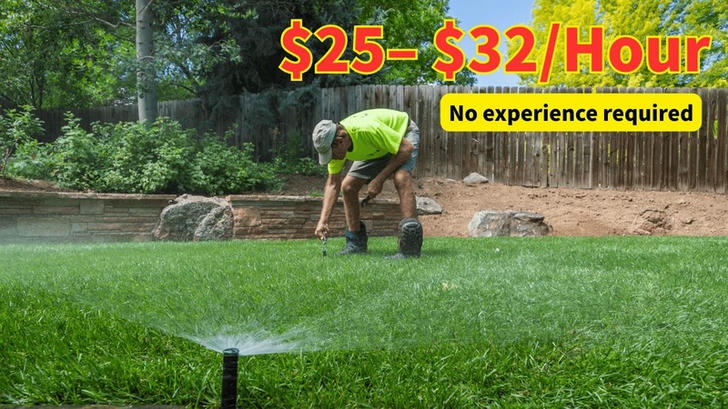
Take JRL Lawn Sprinkling Systems Inc. in Addison, Illinois, for example. The company is hiring full-time irrigation technicians with:
- Pay ranging from $ 25 to $ 32.50 per hour
- 401(k) retirement plan and paid time off
- Performance-based bonuses
- On-the-job training—no prior experience needed
Applicants need only a valid driver’s license, a high school diploma (or equivalent), and the ability to work outdoors. For many job seekers, this combination of stability, structure, and accessibility is increasingly rare.
What the Role Actually Offers (Based on Real Listings)
✅ Compensation: $ 25– $ 32.50/hour for full-time work
✅ Benefits: 401(k), paid vacation, bonuses
✅ Training: Employers like JRL explicitly welcome beginners
✅ Schedule: Day shifts (8–10 hours), occasional weekends
✅ Requirements: Valid driver’s license (no DUI), basic mechanical aptitude
✅ Duties:
- Troubleshoot valves and electrical components
- Program and replace irrigation controllers
- Adjust sprinkler heads for optimal coverage
- Perform seasonal maintenance (spring startup, winterization)
- Ensure customer satisfaction through clear communication
No exaggerated claims—just consistent, hands-on work with tangible results.
Why Demand Is Growing 📈
According to the National Association of Landscape Professionals (NALP), over 70% of landscape companies report difficulty hiring reliable field staff. At the same time, smart irrigation systems—equipped with weather sensors, soil moisture monitors, and remote control—are becoming standard in residential and commercial properties.
This shift means today’s irrigation technician isn’t just turning wrenches—they’re interpreting system alerts, calibrating efficiency settings, and advising property owners on water conservation. The role blends physical skill with technical literacy.
And because irrigation follows natural cycles (busy in spring/summer, lighter in fall/winter), it offers predictable workflow—unlike gig economy unpredictability.
Who’s a Good Fit? Age-Based Considerations
| Age Group | Strengths | Considerations |
|---|---|---|
| 21–25 | Quick learners, high energy, open to skill-building | May need support developing long-term work habits; outdoor demands can be physically intense at first |
| 26–45 | Strong reliability, communication skills, often seeking stable income | Balance family time with occasional weekend calls; upskilling in smart systems boosts advancement |
| 46+ | Detail-oriented, disciplined, often bring transferable experience (construction, farming, maintenance) | Assess comfort with prolonged standing, bending, or lifting; many employers allow task adjustments based on capability |
Note: Suitability depends on individual health, interests, and local climate—not age alone.
How to Apply 📩
The process is typically straightforward:
- Submit a resume via platforms like ZipRecruiter or Indeed
- Or email directly if a contact is provided (as with JRL’s listing)
- Some local companies accept a brief introductory text
Resumes don’t need to be elaborate. Highlight punctuality, clean driving records, any mechanical exposure, or customer-facing roles—even retail or food service shows reliability.
The Bigger Picture: More Than Just “Fixing Sprinklers” 🌍
As states like California, Texas, and Arizona enforce stricter water-use regulations, efficient irrigation is no longer optional—it’s essential. Technicians who understand water-saving technologies are becoming key players in urban sustainability.
In an era where AI automates routine tasks, jobs requiring on-site judgment, human interaction, and adaptability remain resilient. Irrigation work is one of them.
It won’t make you a millionaire. But it can offer steady pay, benefits, fresh air, and the quiet pride of keeping communities green—one well-tuned sprinkler at a time. 💧🏡